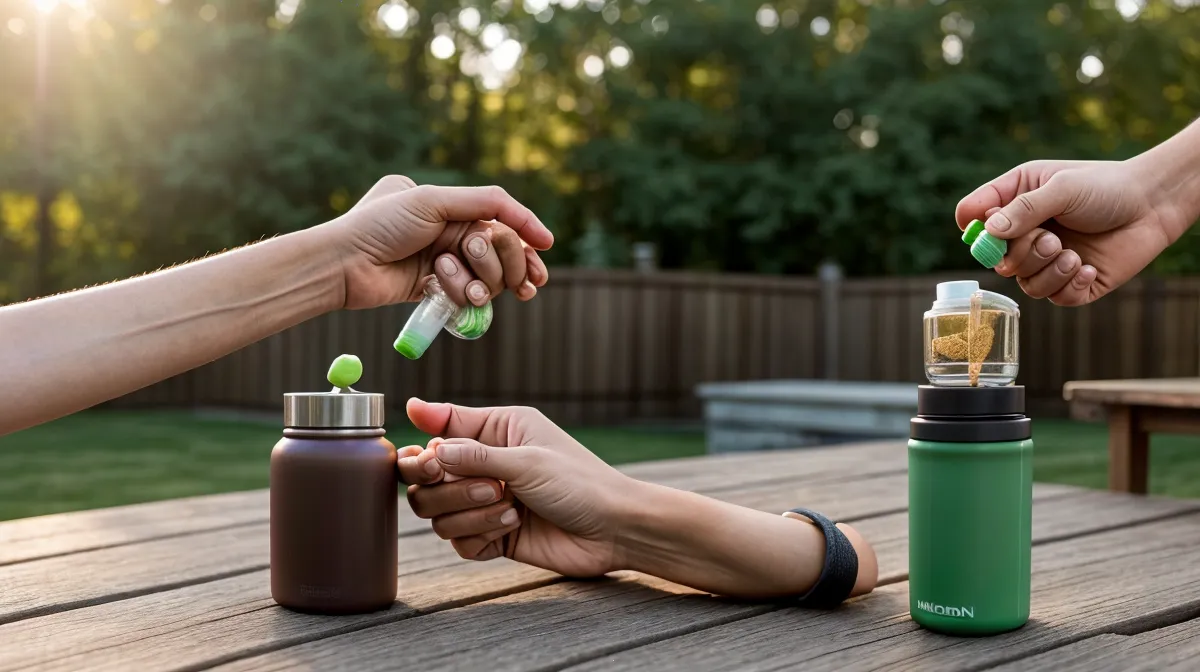
Six days into cutting every capsule out of my morning lineup, including the prostate formula I've leaned on for months since turning fifty-two, I'm at the kitchen counter, sorting pills back into their bottles like a guy conceding a bet he doesn't remember making. Real supplement testing, for a guy my age, means stopping the whole stack at once, not just the one product you suspect, and letting your body tell the truth before you trust the label.
Quick heads-up before the results: some of the links ahead, including the ones for Protoflow, are affiliate links, and I earn a small commission if you buy through them at no extra cost to you. I only write about products I've actually swallowed myself, this one included, so take this as one guy's field notes and not a doctor's opinion.
What Actually Counts as a Supplement Break?
A break only tells you anything if it's total. I didn't quietly swap the prostate capsule for a placebo; I killed the whole morning stack at once, fish oil, magnesium, the softgel my doctor's office would file under support for Benign prostatic hyperplasia, all of it, for a full seven days. Think of it like an electrician pulling every breaker in the panel instead of flipping one switch and guessing: you only find out what's actually wired to what if you cut the whole circuit at once. I'd been taking Protoflow most mornings for months, and by comparison I'd started feeling so unremarkable that I got suspicious of my own supplement: was it doing the work, or had I just gotten lucky for a while?

Rule Out the Confounders Before You Trust the Result
Here's the thing that makes any self-experiment like this messy: your body doesn't run in a lab, it runs through an ordinary week, and ordinary weeks lie to you constantly. I found that out the hard way running six straight weeks of hardcore 16:8 intermittent fasting last year, expecting a clean jump in energy and getting mostly hunger headaches and a grumpier version of myself, nothing I could honestly separate from normal week-to-week noise. So going into the supplement break, I tried to hold everything else dead steady, same trail, same bedtime, same coffee, so that whatever changed had a real chance of being about the stack and nothing else.
The First Two Days Feel Like a Victory Lap
The first two mornings, nothing much happens, and that's exactly the trap. I still get out the door for our usual loop on Bear Creek Trail with Max, the water bottle already cold enough to sting my palm before the sun's done anything about the temperature, and I feel almost smug, like my body just decided to handle things on its own. A neighbor a few doors down, training for an upcoming 5K with the local running club, would tell me two good mornings prove nothing, and he'd be right, because two days is just your body coasting on reserves built up from months of the stack actually working.
During those quiet first two days I even found myself eyeing ProstaVive, wondering if I needed the stronger stuff at all — I've gone deep on the midnight shuffle and my experience with these different formulas elsewhere, but two good mornings had me convinced I could walk away from all of it.
A System-by-System Rundown of What Changes
By day four, the changes stop being subtle, and they don't show up in just one place. Energy goes first, not a crash, just a flatter afternoon that makes the coffee taste more necessary than usual, and it nudges you to wonder, fairly, whether what you're feeling is age-related testosterone decline or just a rough week at the desk, which is a harder question to answer honestly than most guys admit. My knees and lower back, already doing extra work to hold onto muscle in my fifties, start feeling like they're working without a spotter. The stiffness in my shoulders when I reach for something on a high shelf is a reminder that joint mobility isn't separate from whatever else is happening inside; it's just the part you can feel with your hands.
My gut gets loud too, more bloating after dinner than I'd account for from what I actually ate, which tells you digestive function is more tangled up with the rest of the stack than any label admits. Even the dog walk changes shape, my stride gets a half-step shorter, and I notice my boots more than I should, which is its own reminder that foot and gait mechanics matter more once you're past fifty and still expect your feet to cooperate without complaint. It's the same low-grade discomfort I remember from before I moved away from the dad bod lifestyle in the first place, proof that ignoring your age doesn't make the problems go away; it just gets quieter about it until you stop paying attention. Max, for the record, shows zero signs of a supplement-withdrawal slump; that dog has more energy on his worst day than I have on my best, stack or no stack.

Sleep is where it gets loudest, though I'm not going to turn this into a play-by-play of every trip down the hallway, just know quality drops before quantity does, and that's its own kind of sleep disruption worth separating from anything prostate-specific. My metabolism doesn't visibly slow down in a week, but the scale creeps in a direction I don't like, which is exactly the kind of thing that makes a guy suspicious of metabolic slowdown even when he can't prove cause and effect in seven days. Circulation is the sneaky one: cold hands earlier in the evening than usual, nothing dramatic, just a reminder that blood flow support isn't only about gym performance. My focus at the desk gets grainy by mid-afternoon, less a sharp cognitive lapse and more a general dulling, which is exactly the kind of thing a guy blames on a bad night's sleep before he considers anything else. That's the trap with symptom attribution: everything overlaps, and without some kind of running log, you'll credit or blame the wrong variable every time.
A plain running log is what saves you here: dates and one-line notes, nothing fancy, because any self-tracking methodology only works if you actually look back at it instead of trusting your memory of how last Tuesday felt. Reading a label with real supplement ingredient literacy helps too, if only so you know exactly which ingredient you're testing instead of guessing at a proprietary blend. And keeping the rest of the routine boring, same wake time, same walk, same water bottle before the Colorado altitude and its usual dehydration nonsense catches up with me, is the only way routine adherence lets the missing supplement be the one variable that actually moved.
Does Going Back On It Actually Confirm Anything?
Getting back on the stack over the following weekend feels almost anticlimactic. I went back to my regular dose of Protoflow, and the flatness fades within a couple of days: energy less sluggish, joints quieter, sleep deeper. I even flirt with switching to FlowForce Max for the gummy format, since chewing something with breakfast beats swallowing another capsule with coffee, though for now I'm sticking with what actually got me back to normal.
The real proof isn't anything I can log in a spreadsheet. It's the short rise two blocks from the house that Max hauls me up every single morning, and whether I clear it without a flicker of dread or end up negotiating with my own legs by the top.
The One Rule Every Guy Testing Supplements After 50 Should Follow
None of this needs to be complicated. Stop the whole stack for a week, hold everything else steady, and judge the result by how you move through an ordinary morning, not by whether you feel some dramatic crash: that's the one rule worth carrying out of a week like this. If the prostate side of your own stack is the piece you're most curious about, Protoflow is the one I keep coming back to, though your own doctor should have the final say before you change anything in your routine.