A buddy of mine texted me a link to some "ultimate longevity stack" last month — fourteen pills, forty bucks a bottle, a subscription you apparently can't cancel without calling a number in a time zone that doesn't exist. I bought the starter pack because I'm an idiot sometimes, took it for three weeks, and felt exactly the same except forty bucks poorer. My dog Bailey, meanwhile, still has more energy at eleven years old than I did on that stack — she hears the leash rattle from two rooms away and I need coffee just to open my eyes.
Here's the thing — after the "well, at your age" conversation with my doctor a couple years back, I started actually reading the research behind the stuff piling up on my kitchen counter instead of trusting whatever the label promised. Some of it holds up. A lot of it doesn't. This page is the cheat sheet I wish I'd had when I started: what the actual studies say about the ten ingredients that show up over and over on supplements marketed at guys over 50, numbers pulled straight from the source instead of from whatever a copywriter felt like rounding up to.
Not a doctor. Not a biohacker. Just a 52-year-old in suburban Denver who got tired of guessing. Think of it like pulling the actual maintenance records on a used car instead of taking the seller's word that it "runs great" — half the time the paperwork tells a different story than the pitch.
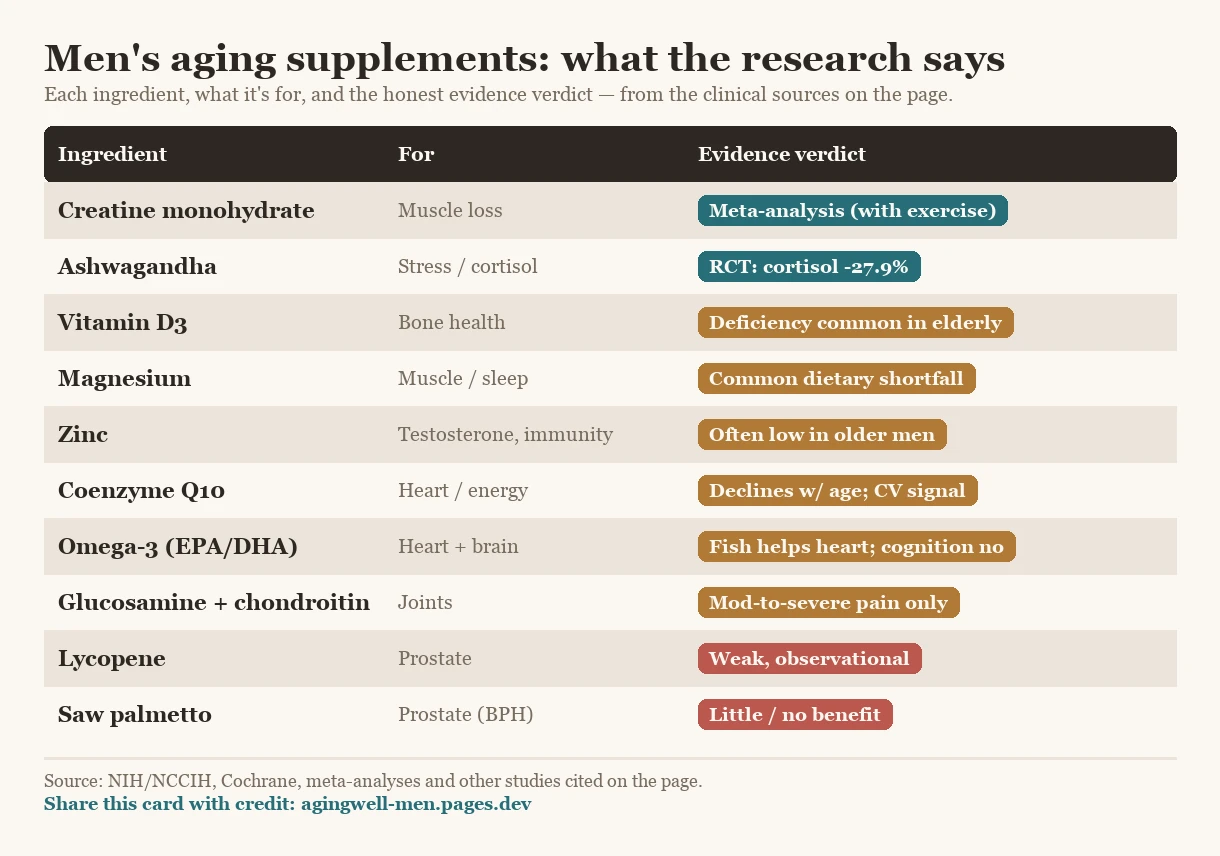
The honest read: of the ten ingredients marketed to men over 50, only creatine (paired with resistance training) and ashwagandha have solid trial evidence — saw palmetto and lycopene barely move the needle, and omega-3 is linked to heart health (mostly from eating fish) but did nothing for memory in healthy older adults.
Ingredient Comparison Table
The table below covers ten ingredients you'll see on nearly every bottle marketed at guys our age. I kept this part deliberately boring and precise — confidence intervals and all — because this is the section I don't want to editorialize. Read it cold.
| Ingredient | Primary Biological Role | Common Aging-Related Application | Research Observation / Prevalence |
|---|---|---|---|
| Vitamin D3 (Cholecalciferol) | Calcium absorption; immune modulation | Bone density and skeletal health | A global meta-analysis found vitamin D deficiency (levels below 20 ng or 50 nmol) affects an estimated 59.7% of older adults (95% CI 45.9%-72.1%) (PMC). |
| Magnesium (Glycinate/Citrate) | Cofactor in 300+ enzymatic reactions | Muscle function and sleep quality | Almost half (48%) of the US population consumed less than the required amount of magnesium from food in 2005-2006, down from 56% in 2001-2002 (PubMed). |
| Omega-3 Fatty Acids (EPA/DHA) | Structural component of cell membranes | Cardiovascular and cognitive health | Regularly eating fish and seafood is consistently associated with a lower risk for cardiovascular disease (AHA). A Cochrane review of randomized trials found no benefit of omega-3 supplementation on cognitive function in cognitively healthy older adults (PubMed). |
| Coenzyme Q10 (Ubiquinone) | Mitochondrial energy production | Heart health and cellular energy | Tissue-level studies show ubiquinone (CoQ10) content peaks around age 20 in most organs and declines steadily with further aging (PubMed). CoQ10 levels decline in some tissues with aging, and supplementation has shown benefits in aging-related cardiovascular and metabolic conditions (PMC). |
| Zinc | Protein synthesis; immune function | Testosterone support and immunity | Zinc deficiency is linked to male hypogonadism, and elderly adults have been shown to have lower plasma zinc levels than younger adults (PMC). |
| Saw Palmetto (Serenoa repens) | 5-alpha-reductase inhibition | Prostate health (BPH) | NCCIH concludes saw palmetto is probably not helpful for BPH-related urinary symptoms; a 2023 review of 27 studies found the herb, taken alone, provides little or no benefit (NCCIH). |
| Creatine Monohydrate | ATP regeneration in muscle cells | Sarcopenia (muscle loss) prevention | A meta-analysis of 405 older adults (average age 64) found creatine supplementation combined with resistance training produced greater gains in muscle mass and upper-body strength than resistance training alone (JISSN). |
| Glucosamine & Chondroitin | Cartilage matrix maintenance | Joint mobility and comfort | In the GAIT trial, combined glucosamine and chondroitin produced a significantly higher response rate than placebo in the moderate-to-severe knee pain subgroup (79.2% vs. 54.3%, P=0.002); the overall study population showed no significant benefit (PubMed). |
| Ashwagandha (Withania somnifera) | Adaptogenic cortisol regulation | Stress response and vitality | In a 60-day randomized trial, ashwagandha root extract reduced serum cortisol by 27.9% from baseline, compared with a 7.9% reduction on placebo (PMC). |
| Lycopene | Carotenoid antioxidant | Prostate tissue protection | A meta-analysis of 23 studies found a statistically significant but weak inverse association between dietary lycopene/tomato intake and prostate cancer risk (OR 0.94, 95% CI 0.89-1.00), based solely on observational data — not strong enough to support a standalone recommendation (PubMed). |
Functional Categories and Research Status
- Hormonal Support
- Zinc, Vitamin D, and Ashwagandha get lumped together because they all touch the hormone stuff nobody brings up at a barbecue. I started on ashwagandha during a rough stretch at work — my father-in-law swore by it, called it "nature's Xanax," which is exactly the kind of unhinged claim that made me skeptical enough to go find the actual trial instead of just taking his word for it. Turns out the real effect is decent, not miracle-drug decent. Just genuinely better than placebo, which is more than I can say for half of what's in my medicine cabinet.
- Musculoskeletal Maintenance
- Creatine and Vitamin D3 are the two I actually stuck with, mostly because I could feel the difference doing yard work — the kind of Saturday that used to leave my lower back wrecked for two days afterward. My physical therapist compared it to keeping oil topped off in an engine that's been running low for years: it doesn't fix a bad part, it just stops things from grinding. Neither one does anything without the resistance training, though. I learned that the hard way after three months of taking creatine and doing basically nothing with it — no difference. Zero. The pills were not going to lift the mulch bags for me.
- Cardiovascular and Metabolic Health
- Omega-3 and CoQ10 get marketed together as a heart-and-energy combo, and I'll be straight with you — the fish oil part checks out for heart health. But I bought the "omega-3 sharpens your memory" pitch for a solid year before I found the actual trials on cognitive function, and they come back empty. No benefit, plain and simple, in people who started out cognitively healthy. I still take it, for the heart reasons. I just stopped expecting it to help me remember where I put my reading glasses, which are usually on my head.
- Urological Health
- Saw Palmetto and Lycopene show up on almost every bottle aimed at guys our age, and this is the one where I have to be the bearer of bad news: saw palmetto, taken by itself, mostly just doesn't do much — according to the people who actually reviewed the studies, not according to me. I took it for four months on a friend's recommendation a while back and honestly couldn't tell you if anything changed. Lycopene has a real but modest signal in the research — more "eat more tomato sauce" than "buy the sixty-dollar supplement."
Last verified: 2026-07-11
A quick disclaimer, since some of this touches actual health decisions: everything on this page comes from me reading the research and testing bottles on myself. It's not medical advice, and I'm not your doctor — I'm just a guy who got curious. Everybody ages differently; what did nothing for my joints might do plenty for yours, and vice versa. Talk to your own doctor or pharmacist before adding anything here to your routine, especially if you're already on prescription meds. One worth flagging specifically: if you're on a blood thinner like warfarin, both fish oil (omega-3) and CoQ10 can interact with it — CoQ10 can blunt how well warfarin works, and high-dose fish oil can add to bleeding risk. That's not a guess-and-check experiment to run on your own kitchen counter; get your doctor's sign-off first.
Sources
- PMC / National Library of Medicine: The Global Prevalence of Vitamin D Deficiency in the Elderly: A Meta-Analysis
- PubMed / National Library of Medicine: Suboptimal Magnesium Status in the United States
- American Heart Association (AHA): Fish and Omega-3 Fatty Acids
- PubMed / Cochrane Database of Systematic Reviews: Omega 3 Fatty Acid for the Prevention of Cognitive Decline and Dementia
- PubMed / National Library of Medicine: Age-Related Changes in the Lipid Compositions of Rat and Human Tissues
- PMC / National Library of Medicine: The Paradox of Coenzyme Q10 in Aging
- PMC / National Library of Medicine: Zinc: Role in Immunity, Oxidative Stress and Chronic Inflammation
- National Center for Complementary and Integrative Health (NCCIH): Saw Palmetto
- Journal of the International Society of Sports Nutrition (JISSN): ISSN Position Stand: Creatine Supplementation
- PubMed / New England Journal of Medicine: Glucosamine, Chondroitin Sulfate, and the Two in Combination for Painful Knee Osteoarthritis (GAIT)
- PMC / National Library of Medicine: Safety and Efficacy of a High-Concentration Ashwagandha Root Extract
- PubMed / National Library of Medicine: Efficacy of Lycopene Intake in Primary Prevention of Prostate Cancer